Leder Games
Root landed in 2018 from designer Cole Wehrle, artist Kyle Ferrin, and publisher Leder Games, and it quickly became one of the most discussed strategy games in the hobby. Players take on the roles of rival factions fighting for control of a shared woodland, each operating under completely different rules, different actions, and different paths to victory. It is an asymmetric game in the truest sense, where the word “asymmetric” means something far more radical than slight stat differences between otherwise similar characters.
Reception has been overwhelmingly positive. Root won the 2018 Golden Geek Board Game of the Year, swept the 2019 Origins Awards with Game of the Year, Best Board Game, and Fan Favourite, and earned the American Tabletop Awards Complex Game award. Community sentiment is strongly favorable, with the game sitting comfortably in the upper tier of strategy game rankings years after release. It also attracts a vocal minority of critics who find its demands too steep, its balance too uncertain, or its social dynamics too aggressive. Both perspectives are worth understanding before buying in.
What Makes Root Click
Asymmetry is the headline, and it runs deeper here than in almost any other competitive board game. Each of the four base factions plays by fundamentally different rules. The Marquise de Cat operates as an occupying empire, spreading across the map and scoring points by constructing buildings like sawmills, workshops, and recruiters. The Eyrie Dynasties build power through an escalating decree system that forces increasingly ambitious actions each turn, scoring based on the number of roosts they control, but risking a devastating collapse into turmoil if they cannot fulfill their programmed orders. The Woodland Alliance spreads sympathy tokens across the map to represent growing insurgent support, gaining strength every time opponents interact with sympathetic clearings. And the Vagabond walks a completely different path, a lone adventurer who cannot rule clearings at all but scores by building relationships with other factions, completing quests, and removing enemy pieces. These are not variations on a shared framework. They are four distinct games playing out on the same board.
Player interaction is where Root separates itself from the crowded field of competitive strategy games. This is not a design where players build their own engines in quiet parallel. Every action ripples across the table. Attacking one faction shifts the balance of power in ways that benefit a third. Leaving someone unchecked for a round can hand them a runaway lead. Table talk, informal alliances, threats, and persuasion are woven into the fabric of every session. Community discussion consistently highlights this political dimension as the quality that keeps Root on the table long after other strategy games have been shelved. Winning often depends as much on reading your opponents and managing perceptions as it does on optimizing your own faction’s engine.
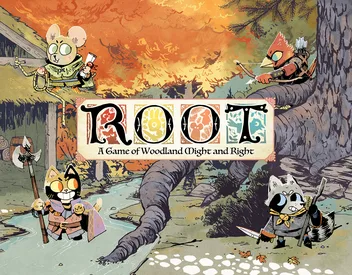
Kyle Ferrin’s artwork deserves recognition for what it contributes to the experience. His hand-drawn, ink-and-wash style gives the woodland creatures a personality that sits perfectly between charming and fierce. Cats in military garb, birds of prey issuing decrees, a raccoon wandering the forest with a knapsack of items. The visual identity makes Root instantly recognizable and draws players in before they’ve learned a single rule. More importantly, it serves the gameplay. Each faction’s visual design communicates its role and personality, making the asymmetric systems feel intuitive in a way that bare mechanics alone would not achieve.
Replayability runs deep because every combination of factions and players produces different dynamics. A four-player game with the Marquise, Eyrie, Alliance, and Vagabond plays nothing like the same four factions with different people at the controls, because the political dynamics shift with every personality at the table. Switching factions between sessions reveals entirely new strategic problems. Many players report that Root only gets better as a group accumulates shared experience, with games growing tighter and more competitive over dozens of sessions.
Root’s Rough Edges
Learning curve and teaching difficulty are the most consistent pain points in community discussion. Each player needs to understand their own faction’s rules and how every other faction operates, because you cannot make good strategic decisions if you don’t know what your opponents are capable of. The base rules that apply to everyone are relatively simple: turns flow through Birdsong, Daylight, and Evening phases, combat uses two dice with the attacker taking the higher roll and defender taking the lower, and the shared card deck serves multiple functions from crafting to faction-specific abilities. But the faction-specific complexity stacks on top of that shared foundation, and absorbing four different rule sets at once creates information overload for newcomers. Teaching adds significant time to a first session, and that first game is almost universally described as a stumbling, confusing experience that barely resembles what Root becomes with familiarity.
Vagabond balance is the most debated design element in the game. A substantial portion of the community feels that the Vagabond scores too easily, particularly against groups that don’t understand how to collectively pressure a lone adventurer. Because attacking the Vagabond costs actions without yielding much direct benefit, newer groups often let the Vagabond roam freely, and the faction runs away with points. Experienced tables learn to police the Vagabond, but this creates a knowledge gap that can warp early sessions. Some players view this as a feature of the game’s political system. Others see a balance problem baked into the design. Where a group falls on this question depends heavily on how many sessions they have under their belt.
Two-player Root is widely considered the weakest way to experience the game. With only two factions on the board, the political negotiation that makes the game sing at higher counts disappears entirely. Certain two-player matchups are lopsided, and the dynamic tension between multiple competing interests collapses into a flat head-to-head contest. Expansions and automated opponent systems address this to some degree, but the base game at two players is a significantly diminished experience compared to three or four.
Root requires a committed group in a way that most games do not. Players who try it once or twice and walk away often come away unimpressed, because early sessions are marked by confusion, lopsided outcomes, and a feeling that the factions are wildly unfair. Community forums are full of players who disliked Root for their first several games before something clicked on the fourth or fifth play. That investment of time and patience, ideally with the same group learning together, is not something every table can or wants to provide. If Root lives or dies on accumulated familiarity, then the price of admission is higher than the box suggests.
The Familiarity Problem
Root’s central tension is that everything wonderful about it exists on the other side of a significant learning investment. The political maneuvering only works when everyone at the table understands what every faction can do. The balance only holds when players know how and when to check a runaway leader. The strategic depth only reveals itself after multiple sessions with multiple factions. First impressions of Root are frequently mediocre, and the game asks players to trust that it will get better.
For groups that make that investment, it almost always does. But this creates a recommendation problem. Telling someone to buy a game and play it five times before judging it is a tough sell, especially in a hobby where most tables have dozens of unplayed games competing for attention. Root rewards loyalty like few other designs, but it asks for that loyalty upfront, on credit.
Should You Play Root?
Root belongs on the shelf of any group that meets regularly, enjoys direct conflict, and is willing to learn a game together over multiple sessions. Four players is the ideal count, where all four base factions create an interlocking ecosystem of competition and negotiation. Three works well with careful faction selection. Solo and two-player experiences require expansion content to feel complete.
Skip it if your group rarely replays games, if you prefer low-conflict optimization puzzles, or if teaching a 30-minute rules explanation sounds like a deal-breaker. Root is not a game that works at a casual game night with rotating guests. It is a game for a dedicated table.
The Verdict on Root
Root is one of the most ambitious asymmetric designs in modern board gaming, and it delivers on that ambition with startling confidence. Every faction feels like its own game, yet they all interlock into a competitive ecosystem that rewards table talk, strategic reading, and repeat play. It demands a committed group willing to push through awkward early sessions, and it stumbles at two players without expansion support. But for a regular table of three or four who want a game that keeps evolving over dozens of sessions, Root is an extraordinary achievement that has earned every award on its shelf.