Czech Games Edition
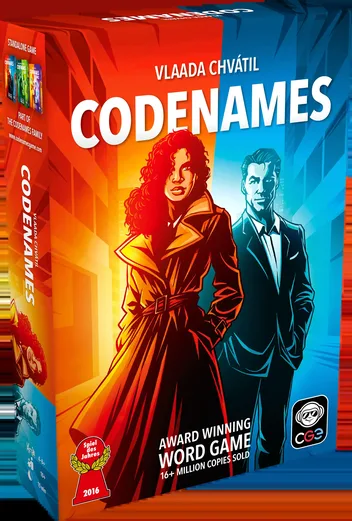
Codenames
2015 · 4-8+ Players · 15-30 min · Competitive / Party / Word Association
Designed by Vlaada Chvatil and published by Czech Games Edition in 2015, Codenames became a phenomenon almost immediately. It won the 2016 Spiel des Jahres, swept multiple Origins Awards, and has since sold over 14 million copies in 38 languages. Community reception has been overwhelmingly positive, and it remains one of the highest-rated party games on every major ranking platform. For a game built entirely around saying one word and a number, that kind of staying power says something.
Two teams compete to identify their agents from a grid of 25 word cards, guided only by single-word clues from their team’s spymaster. One wrong guess can hand the other team an advantage or, worse, hit the assassin and end the game instantly. Underneath the simple rules sits a game that generates real tension, genuine laughter, and the kind of memorable moments that keep groups coming back for years.
Codenames’ Player Interaction Shines
Accessibility is the foundation everything else is built on. A new player can learn Codenames in under five minutes. Twenty-five words sit on the table, each team has a spymaster who knows which words belong to which side, and the spymaster gives a one-word clue followed by a number indicating how many words relate to that clue. Guessers touch cards to make their picks. Correct guesses let the team keep going, up to the stated number plus one. Wrong guesses end the turn. That’s essentially the whole game, and it works for people who have never touched a hobby board game in their lives.
What elevates Codenames above other word games is the pressure on the spymaster. Crafting a clue that links two or three of your team’s words without accidentally pointing toward the opposing team’s words, a bystander, or the assassin is a puzzle that engages a completely different part of your brain than most party games ask for. When a spymaster drops a clue that connects four words and the team nails every one of them, the table erupts. Few party games produce that kind of collective triumph with such regularity. That rush of a perfectly understood clue is the engine that drives repeat plays.
Replayability runs deeper than you’d expect from a box this small. With 200 double-sided word cards offering 400 possible codenames and 40 key cards determining the layout of agents, bystanders, and the assassin, the combination space is enormous. Two games played back to back will present entirely different puzzles. The words themselves are common enough to be universally recognizable but varied enough that the connections between them shift constantly depending on which 25 end up on the table.
Scaling for large groups is another major strength. Most party games strain past six players, but Codenames actually improves as teams grow. With three or four people per side, the guessing phase becomes a lively negotiation where teammates debate which word the spymaster meant. That table talk is where much of the fun lives. Playing with people you know well opens up clue strategies based on shared experiences and inside references, which gives the game a personal dimension that purely mechanical designs can’t match.
Where Codenames Stumbles
Spymaster downtime is the criticism that appears in virtually every community discussion, and it’s earned. While one spymaster agonizes over the perfect clue, everyone else waits. In a fast-paced party game, those silences can drain momentum. The box includes a sand timer that either team can flip to nudge a slow spymaster, but many groups ignore it or feel rude using it. Analysis paralysis is baked into the role. The spymaster wants to link multiple words while dodging traps across the entire grid, and that mental load takes time. Groups that enforce a loose time limit tend to have a better experience, but the game doesn’t do much to solve this on its own.
Being a guesser is less engaging than being the spymaster. Operatives spend most of their time reacting to someone else’s clue rather than generating ideas, and when it’s not even their turn, there’s nothing to do but watch the other team deliberate. At four players, this is manageable because turns cycle quickly. At larger counts, the wait between meaningful decisions for any single guesser can stretch. The game is at its best when guesser groups are large enough that the debate over which word to pick becomes its own form of entertainment, but in smaller configurations, the operative role can feel passive.
Randomness in the word layout creates occasional frustration. Sometimes the 25 words on the grid align perfectly for creative multi-word clues, and the spymaster feels brilliant. Other times, the team’s words share no obvious connections while sitting dangerously close to the assassin or opposing agents, and the spymaster is stuck giving cautious one-word, one-number clues that inch the team forward. That variance is inherent to a game with random setup, and over many rounds it evens out. But a single lopsided round can feel deflating, especially when the other team’s grid happens to be far more cooperative.
Accidental information leaks from the spymaster are a persistent low-level problem. A wince after giving a clue, a hesitation before saying the number, a relieved exhale when the team picks correctly. These micro-signals give guessers more information than the rules intend. Experienced groups learn to police this, and competitive players develop a poker face. But in casual settings, the boundary between fair play and accidental hints gets blurry, and it can create friction when one team feels the other’s spymaster gave too much away through body language.
Two Roles, Two Games
Here is the thing that most determines whether Codenames clicks for a given group. The spymaster and the operative are playing fundamentally different games at the same table. Spymasters are solving a creative constraint puzzle under pressure, scanning the grid for hidden connections while avoiding landmines. Operatives are interpreting a single word and debating its possible meanings with teammates. Both roles are valid, but they deliver very different levels of engagement.
Groups where everyone takes turns as spymaster across multiple rounds tend to love the game for years. Groups where the same people always end up giving clues while others passively guess tend to burn out faster. Rotating the spymaster role frequently is the simplest way to keep the game fresh, and the best sessions happen when every player gets at least one turn in the hot seat.
Should You Play Codenames?
Codenames belongs in the collection of anyone who hosts game nights, family gatherings, or social events where not everyone at the table is a dedicated gamer. It teaches in minutes, plays in under half an hour, and accommodates groups that most games can’t handle. Six to eight players is the sweet spot, where team debate and social energy are at their peak. Four works fine for a quicker, tighter contest. Below four, look at Codenames: Duet, which was purpose-built for smaller groups.
Skip it if your group hates downtime, if party games feel too lightweight for your taste, or if the idea of sitting quietly while someone else thinks for two minutes sounds miserable. Also skip it if your group is prone to arguments about clue validity, because those debates will happen.
The Verdict on Codenames
Codenames earns its place as one of the defining party games of the modern era through a design that turns word association into a tense, social, and surprisingly strategic team contest. The spymaster role delivers some of the most satisfying moments in any party game, and the barrier to entry is close to zero. Downtime and the gap between the spymaster and guesser experience keep it from perfection. But with the right group size and a willingness to keep the pace moving, this is a game that belongs in nearly every collection.