Libellud
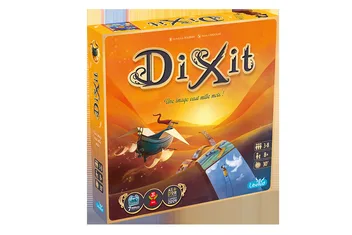
Dixit arrived in 2008 from French designer Jean-Louis Roubira, published by Libellud and illustrated by Marie Cardouat, and it quickly became one of the most successful party games in modern board gaming history. It won the Spiel des Jahres in 2010, has sold over 12 million copies worldwide, and spawned more than ten expansion sets. Players take turns as a storyteller, offering a clue inspired by one of their hand cards, while everyone else submits a card from their own hand that they think fits the clue. All cards are shuffled, revealed, and voted on. Getting people to guess your card is the goal, but the twist is that if everyone guesses correctly or nobody does, the storyteller scores nothing. Clues have to land in a sweet spot between too obvious and too obscure.
Community reception has been overwhelmingly warm, particularly among families, casual gamers, and people who rarely touch hobby board games. Discussion tends to be less divided than it is segmented. Players who value creativity and social connection love it deeply. Those looking for strategic weight or competitive tension find less to hold onto. Both responses make sense given what the game is trying to do, and understanding the difference is the key to knowing whether Dixit belongs on your shelf.
Dixit’s Visual Design Shines
Marie Cardouat’s artwork is the engine that makes everything possible. Each of the 84 cards in the base game features a dreamlike, surreal illustration that resists easy interpretation. One card might depict a city growing out of a tree. Another could show a child carrying a lantern into an enormous keyhole. The images sit in a space between fairy tale and fever dream. These images are open-ended enough to support dozens of different readings, which is exactly what the game needs to function. Players consistently highlight the art as what drew them to the box and what keeps them coming back. It creates a mood that is whimsical without being childish, strange without being alienating.
Accessibility is Dixit’s greatest practical strength. Teaching the game takes about two minutes. On your turn as storyteller, you look at your cards, pick one, and say something that hints at it. Everyone else picks a card from their hand that fits your clue. Cards go face-down, get shuffled, and players vote on which one they think belongs to the storyteller. If some but not all players guess correctly, the storyteller earns three points and so does each player who guessed right. If everyone or nobody identifies the right card, the storyteller gets nothing and everyone else scores two. Players also earn a bonus point for each vote cast on their own submitted card. That is the entire game. Kids as young as eight can play on equal footing with adults because imagination doesn’t require experience or study.
What separates Dixit from other party games is that it asks players to think in metaphor and association rather than trivia, speed, or acting. A storyteller might say “homesick” and play a card showing a tree with roots that look like hands reaching into the earth. Someone else might hear that word and submit a card with a bird flying toward a distant light. The connections players make reveal something personal about how they see the world, and that quality gives the game a warmth and intimacy that most party games never approach. Groups that play regularly report that inside jokes and shared references become part of the game’s vocabulary over time, enriching every round.
Dixit also adapts remarkably well to different group personalities. A table of loud, expressive players will generate animated debate about clues and guesses. A quieter group will lean into thoughtful, subtle associations. Neither experience is wrong, and both produce a satisfying session. Few party games handle that range without feeling broken at one end or the other.
Where Dixit Stumbles
Card repetition is the most consistent complaint, and it’s a structural issue. With 84 cards in the base game and six in each player’s hand at all times, a group that plays regularly will cycle through the entire deck within a handful of sessions. Once players start recognizing cards, the clue-giving space narrows. Familiar images lead to familiar associations, and the spark of discovery that powers early plays dims noticeably. Expansions exist and each adds another 84 cards, but the fact that they feel close to mandatory for anyone who plays more than occasionally is a real cost on top of the base purchase.
Strategic depth is limited by design, and that will disappoint a significant portion of hobby gamers. Decisions in Dixit are creative, not analytical. There’s no resource management, no long-term planning, no optimization path. The scoring system encourages calibrating clues to trick some players while guiding others, but that’s a social skill rather than a strategic one. Players who thrive on tight decision spaces and competitive tension tend to bounce off Dixit after a few plays. It’s a game that values feeling over thinking, and not everyone wants that from a competitive experience.
Playing with strangers or loose acquaintances weakens the game considerably. Dixit’s clue system works best when the storyteller can pitch a reference that some players will catch and others won’t. That requires knowing your audience. Among close friends, a storyteller can lean on shared memories, cultural touchstones, or personality quirks to craft the perfect clue. Among people who just met, clues tend to be either too generic or too personal, and the voting round starts to feel random. Community discussion frequently notes this gap. Dixit is a different game depending on how well the players know each other, and with strangers it often loses the quality that makes it special.
Game length can feel unresolved. At 30 minutes with the deck running out, some groups find the experience ends before it fully develops. Rounds move quickly, and by the time everyone has settled into the rhythm of giving and reading clues, the cards are gone. Playing a second round helps, but the base game doesn’t naturally build to a satisfying climax the way longer party games sometimes do.
The Relationship Game
Here’s what will most likely determine whether Dixit becomes a favorite or sits forgotten on the shelf. This is a game about the people around the table more than anything happening on it. The scoring track exists, a winner is declared at the end, and none of that matters nearly as much as the moment when someone gives a clue and you know exactly which card it is because you know exactly how that person thinks.
That social dimension is the source of both the game’s highest highs and its most obvious limitation. When the group chemistry is right, Dixit creates moments of connection that strategy games and trivia games simply cannot. When the chemistry isn’t there, the whole thing deflates into a guessing exercise with pretty pictures. Knowing which situation you’re walking into saves a lot of disappointment.
Should You Play Dixit?
Dixit fits best with families, friend groups who see each other regularly, and anyone looking for a gateway game that doesn’t feel like a gateway game. Five or six players is the sweet spot, where the storyteller has enough wrong answers to make clues interesting. Four works but offers less room to maneuver. Three feels thin. It’s an excellent choice for mixed-age groups where grandparents and kids share a table, and for game nights where not everyone wants to learn something complicated.
Skip it if strategic depth matters to you, if your group is mostly strangers or rotating acquaintances, or if you need a game with long-term replayability out of a single box. Dixit rewards commitment to expansions for groups that play often, and that ongoing investment isn’t for everyone.
The Verdict on Dixit
Dixit turns abstract art into a guessing game powered by imagination, and the result is one of the most accessible and inviting party games of the past two decades. It rewards creativity over strategy and social familiarity over raw skill, which makes it sing with the right group and fall flat with the wrong one. Card repetition and limited depth keep it from being a game you reach for every week, but when the table clicks, nothing else in the party game space quite matches the feeling. For families and friend groups looking for something warm, creative, and different, Dixit earns its Spiel des Jahres.