Repos Production
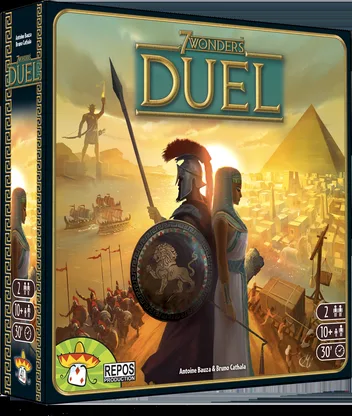
Designed by Antoine Bauza and Bruno Cathala and published by Repos Production in 2015, 7 Wonders Duel adapted the original 7 Wonders into a purpose-built two-player experience. It sold over a million copies in its first five years, doubling the pace of its predecessor, and swept the 2015 awards season, winning Best 2-Player Board Game and Best Card Game in the community awards alongside dual Origins Awards. Community reception has been overwhelmingly positive, with the game sitting among the highest-ranked two-player titles on every major ranking.
Players compete to build rival civilizations across three ages, drafting cards from an overlapping pyramid structure where some cards sit face-up and others remain hidden until uncovered. Each card you take changes what your opponent can access, and three separate victory conditions keep both players on edge throughout. You can win by pushing the military conflict token all the way to your opponent’s capital, by collecting six different scientific symbols, or by accumulating the most victory points when the third age ends. That triple threat of instant-win conditions gives every turn a weight that most games this short simply cannot match.
The Core Appeal That Defines 7 Wonders Duel
Card selection is the engine that drives everything, and it’s brilliantly designed. Cards are arranged in a layered structure where lower rows overlap upper ones, with face-down cards mixed into the layout. Taking a card from the top might reveal two cards beneath it, and one of those newly visible cards might be exactly what your opponent needs. This creates a constant push-and-pull where you’re weighing what you gain against what you expose. The tension of flipping a hidden card and seeing it change the entire calculus of your turn is something the game delivers consistently across hundreds of plays.
Multiple victory paths prevent the game from becoming a solved puzzle. Military supremacy forces you to watch the conflict track and sometimes take shield cards you don’t want just to avoid getting steamrolled. Scientific supremacy, which requires collecting six different symbols, stays a credible threat because each pair of matching symbols also earns you a powerful progress token from the shared board. Civilian victory through raw points remains the most common outcome, but the mere existence of those instant-win conditions means you can never fully ignore them. Blocking your opponent’s science or military progress often matters as much as building your own engine.
Wonder construction adds another layer of strategic depth. During setup, players alternate picking from a pool of twelve wonder tiles until each has four. Some wonders grant raw victory points, others provide shields or coins, and a few offer the coveted extra turn, which lets you take two consecutive actions. That drafting phase before the game even starts creates meaningful decisions, and experienced players recognize that the wonder draft often shapes the entire contest.
Games wrap up in about 30 minutes, and the pacing rarely drags. Turns are quick because you only have three options: construct a building by paying its cost, discard a card for coins (two plus one per yellow card in your city), or tuck a card under one of your wonders to build it. The resource economy works cleanly, with brown and grey cards producing materials that persist turn after turn and a trading system that lets you buy missing resources at a cost influenced by your opponent’s production. Chains let you build certain later-age cards for free if you constructed their prerequisite, rewarding forward planning without adding complexity.
7 Wonders Duel’s Luck Factor Problem
Randomness bites harder than the game’s reputation suggests. Three cards are secretly removed from each age deck before play begins, which means a science victory might be impossible from the start if key symbols got discarded. You can’t know this until the age plays out and the card you needed never appears. Face-down cards in the pyramid compound the issue. Sometimes you flip a card at a critical moment and hand your opponent exactly what they needed through pure chance. For a game that rewards careful tactical play, these swings can feel like they undermine the skill that got you there.
Wonder balance is a persistent concern. Wonders that grant an extra turn are consistently picked first among experienced players because consecutive actions offer a massive tempo advantage. When one player ends up with more of these extra-turn wonders through the draft, the resulting asymmetry can feel lopsided. The game caps total wonders at seven (preventing the eighth from being built), but that structural limit doesn’t fully address the power gap between the best and worst wonder tiles.
First-player advantage has become a talking point as the competitive community has matured. Analysis from online play suggests the starting player holds a meaningful edge, partly because they get the first pick from the card structure and partly because board manipulation compounds over three ages. Casual groups won’t notice this, but for players treating 7 Wonders Duel as a serious competitive exercise, the imbalance is hard to ignore once you’re aware of it.
Replayability has a ceiling. With only three fixed card layouts (one per age) and twelve wonder tiles, the strategic space starts to feel mapped out after extensive play. The card mix within each age varies because of the three removed cards and the face-down arrangement, but the structural bones stay the same. Experienced players may find that the game’s decision tree, while deep, eventually becomes familiar enough to lose some of its early magic.
The Constant Threat
What sets 7 Wonders Duel apart from most two-player games is how it forces you to play defense and offense simultaneously. In a pure point-scoring game, you can focus entirely on your own engine and hope to outpace your opponent. Here, ignoring the military track might mean a sudden loss when your opponent pushes the conflict token those last few spaces. Neglecting science might let them quietly collect a sixth unique symbol. Even if you’re ahead on points, an instant-win condition can erase all of that in a single turn.
This creates a kind of productive anxiety that most short games can’t sustain. You want to build your economy, but you also need to count your opponent’s shields and track which science symbols they’ve collected. Every card you take is both an investment in your strategy and a denial of your opponent’s options. That dual purpose behind every single decision is what keeps the game compelling even after dozens of sessions.
Should You Play 7 Wonders Duel?
7 Wonders Duel belongs in the collection of any pair of players who want a competitive game with real strategic depth that fits into a 30-minute window. It works brilliantly for couples, roommates, or any two people who game together regularly. The rules take about ten minutes to teach, the iconography requires a few games to internalize, and the strategic layers reveal themselves gradually over repeated plays. It also serves as a strong entry point for players curious about civilization and engine-building games without the time commitment of heavier titles.
Pass on it if you’re looking for something highly thematic or narrative-driven. The ancient civilization setting provides structure but not immersion, and the experience is closer to an abstract strategy contest with a historical veneer. Also pass if you need a game that scales beyond two players, because this one does exactly one thing and refuses to compromise on it.
The Verdict on 7 Wonders Duel
7 Wonders Duel earned its place among the best two-player games through smart design rather than spectacle. The card pyramid, multiple victory conditions, and wonder drafting system work together to create a decision space far richer than the 30-minute playtime implies. Luck and balance issues keep it short of flawless, and veteran players may eventually feel the limits of its replayability. But the core experience of reading the board, blocking your opponent, and threading your own strategy through an ever-shifting card structure remains one of the best things in the hobby for two.